The government has confirmed the rollout timetable for the new landlord database, with registration starting this December. It's compulsory for all private sector landlords, forms part of phase two of the Renters' Rights Act, and comes with penalties for landlords who don't comply. Here's what we know so far, and what it means if you invest in rental property or work with sourcing agents to build a portfolio.
What's being introduced
The database, referred to by government as the "Register Your Property Service", requires landlords of homes let under assured or regulated tenancies to register each property individually. This covers existing tenancies as well as any signed during the rollout period. Landlords will pay £65 per property per year.
Empty homes currently being marketed to let don't need to be registered at this stage, though that's expected to change, with a registration number likely to become a requirement before a property can be advertised.
Key dates
The rollout is regional and staggered over 12 months, rather than a single national start date.
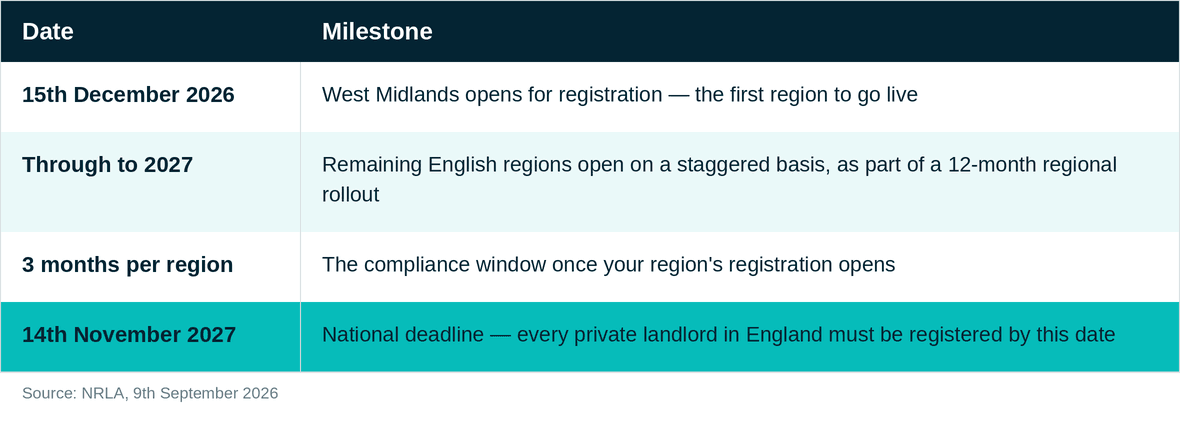
If you own property outside the West Midlands, your own window will open later in the 12-month schedule. It's worth checking the regional timetable directly with the NRLA as further regions are confirmed.
What landlords will need to provide
The government hasn't yet confirmed the full data requirements, but based on what's been signalled so far, landlords should expect to provide:
The property address
Type of ownership (freehold, leasehold, or commonhold)
Property type (detached, semi-detached, terraced, and so on)
Whether the property is licensed
Occupancy details, including whether it's an HMO
Rent amount, whether bills are included, and payment frequency
Relevant safety certificates (gas, EPC, EICR/EIC)
Landlords who haven't got these documents readily to hand would be well placed to start pulling them together now, ahead of their region's window opening.
One important point for anyone working with a sourcing agent
Sourcing agents cannot register a property on a landlord's behalf. Registration has to be done by the landlord themselves. If you're an investor who has built your portfolio through a sourcing agent, this is one compliance step that sits with you directly, not with the person who sourced the deal.
For sourcing agents, this is worth flagging proactively to clients. It won't change the service you provide, but making sure investors understand where their own compliance responsibilities begin is exactly the kind of thing that separates a properly trained, professional sourcing agent from someone dabbling without the right grounding.
Penalties for non-compliance
Landlords who fail to register could face civil penalties of up to £7,000, rising to £40,000 for multiple or continued breaches. Given the scale of the fines, this isn't a piece of admin to leave until the last minute of a region's three-month window.
Also announced: changes to rent increase disputes
Alongside the database news, government also confirmed plans to move responsibility for ruling on Section 13 rent increase disputes from the First-tier Tribunal to the Valuation Office Agency (VOA), with the aim of speeding up the process. This is expected to take around two years to introduce, and a firm start date hasn't yet been set.
What this means if you're building a portfolio
None of this changes the fundamentals of good property investment, but it does add another compliance layer that sits alongside licensing, safety certification, and Renters' Rights Act obligations more broadly. If you're working with a sourcing agent, it's a good moment to check they are clear on these changes and you can speak to them confidently, rather than finding out after the fact that a step has been missed.
If you're a sourcing agent, it's a good moment to make sure your own knowledge is current. NAPSA members have access to compliance guidance and support that's kept up to date as regulation like this develops, so you can advise clients accurately rather than guessing.
Source: NRLA, "Landlord database: Rollout to start in December", 9 September 2026. The NRLA is also hosting a free member webinar on the database on 1 October.